Betty Zumbrugge
The Master Butchers Singing ClubBetty Zumbrugge is a schoolmate of Franz Waldvogel whose confident courtship becomes a brief but revealing episode in his emotional life. She arrives with a car, polished clothes, and a willingness to pursue him; Franz, drawn toward and repelled by her in turn, cannot make the relationship into the uncomplicated romance she appears to seek. Their encounters expose how strongly his unspoken attachment to Mazarine Shimek governs his choices, even when he tries to act as if he has moved on.
Identity and Introduction
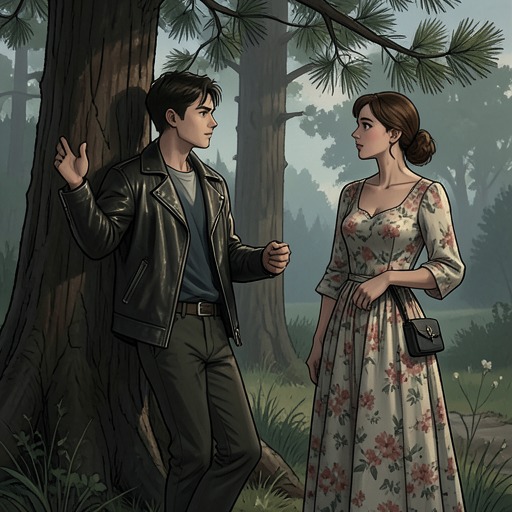
Betty is known at school for the visible signs of comfort and adult polish that set her apart from Mazarine. She drives her father’s car, wears a different dress each day, and has silk stockings; her very blond hair and brilliant scarlet lipstick are remarked upon by other girls. Mazarine’s friends say Betty tries anything to attract Franz, sometimes to the point of looking foolish. Franz, however, does not initially respond to her advances, and Mazarine is too proud to tell him that Betty’s attention troubles her.
Betty’s appearance is not merely background to the courtship: Franz notices its details while struggling to understand what he wants. When he sees her in the car, he considers her carefully arranged hair, lipstick, and the way she smells. He experiences attraction alongside an instinct to escape, a contradiction that becomes central to their brief relationship.
Courtship and the Mazarine Triangle
One day Mazarine sees Franz riding in Betty’s car. Their eyes meet across Betty as she drives, but Franz’s expression is neutral and almost foolish, unlike any expression Mazarine has seen from him before. Betty identifies Mazarine dismissively as a girl with only one dress. Franz immediately objects that this is untrue, but the defense does not become a declaration of affection. He has not spoken to Mazarine since their last day beneath the pine, after which he felt obscurely responsible for the hill’s collapse and its consequences for his brother.
That history makes the moment more than a simple encounter between a boy and a rival suitor. Franz associates his happiness with the near death of Markus, and the thought turns his attention away from Mazarine even as it makes the separation between them painful. Betty’s presence offers a way to move into a different kind of intimacy, but Franz’s divided attention prevents him from meeting her confidently.
Betty invites him to come home with her to help with mathematics. He refuses, saying he has to work and that his father will be waiting at the shop. The excuse gives him a safe, practical reason to leave. Once there, he can laugh and apologize naturally through the car window, although he is aching to be alone. His relief at returning to work shows how responsibility can serve him as an exit from a situation he does not know how to navigate.
The Christmas Date
Despite his earlier evasions, Franz agrees to go out with Betty after school lets out for Christmas. On the first evening of vacation, she drives to the shop in her father’s large black car and waits outside with the motor running rather than coming in. Franz has told his father he is leaving, but not who he is meeting. Fidelis recognizes the car and asks why Betty has not come inside; Franz answers that it is Betty, then leaves with her.
They go to a roadhouse, where Betty talks about her family, her plans to attend nursing school, her sisters and their boyfriends, and her father’s problems. Franz tries to listen but his mind wanders. They drink whiskey with beer chasers. The whiskey’s harsh, sweet burn gives him an amber warmth, and he looks at Betty with an indulgent pleasantness. Yet the contrast with Mazarine persists: despite Betty’s grown-up clothes, makeup, and car, Franz thinks she seems younger than Mazarine. When Betty drinks a third whiskey, he refuses another.
Afterward Betty drives to a quiet road ending at a farm her father foreclosed on the previous spring. They sit in the car with blankets from the back seat while their eyes adjust to the blue snowlight and the town lights recede behind the windbreak. Betty proposes that they talk about their relationship and asks whether he is going to kiss her. The scene gives her the directness Franz lacks: she names the question between them, while he approaches it through teasing and hesitation.
Attraction, Recoil, and Significance
Franz agrees to kiss Betty, first smoothing her lips with a finger and rubbing away her lipstick with his thumb. The gesture briefly holds her attention, but the kiss overturns his expectations. He had expected Betty to kiss like Mazarine; instead, the contact feels unfamiliar and excessive to him. He dislikes the taste and feel of the kiss and becomes dizzy. As Betty falls across the seat with him, his hands move beneath her coat, and he is surprised by how quickly the encounter becomes physically intimate.
When he realizes that her dress has opened and his hands are on her breasts, he stops. He pulls her brassiere down, closes her coat, and turns away. He says he has to get out and walk. The abrupt retreat is the episode’s decisive turn: Betty has offered him an opening into adult intimacy, and he has approached it with curiosity and desire, but the experience does not resolve his divided feelings. His response remains shaped by comparison with Mazarine and by an uncertainty he cannot explain to Betty.
Betty is therefore more than a competing love interest. Through her pursuit, the novel makes Franz’s separation from Mazarine visible in action: he can defend Mazarine against an insult, accept Betty’s invitation, and begin a kiss, yet none of these gestures frees him from the attachment and guilt surrounding the hill’s collapse. Betty’s confidence and material polish meet a boy who is at once drawn to her and already turning away; the encounter ends not in a new courtship, but in his need to leave the car and walk.